|
|
 |
 Cementless Tapered Stem
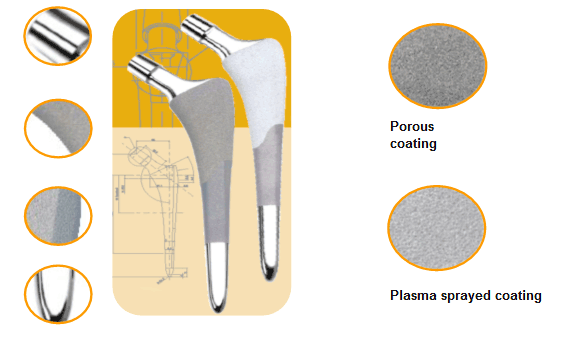
The overall design conception was line to line figure. Due to porous and plasma coated area having 0.5~0.8mm thickness and overall taper stem configuration, the compression stress and hoop stress are efficiently increased during press fit maneuver which results in added stability and fix ability with the host bone. Cementless Tapered Stem
The overall design conception was line to line figure. Due to porous and plasma coated area having 0.5~0.8mm thickness and overall taper stem configuration, the compression stress and hoop stress are efficiently increased during press fit maneuver which results in added stability and fix ability with the host bone. |
The connecting taper to ball head has clinically proven 12/14 taper. This enables both metal taper and ceramic head to fit with more stableconfiguration.
The noncemented stem is composed of Ti-6Al-4V ELI biomaterial with sound biomechanical designed neck shaft angle formulating 132 degrees.
The proximal cross was section was designed to have optimal rotational stability.
The shapes of the distal part of stem is kept rectangular and relatively slender and distal tip of the stem has polished surface with bullet configuration reducing the friction with the cortex and leading more smooth and safe insertion of the stem. |
|
| |
| |
| Cement Polished Tapered Stem
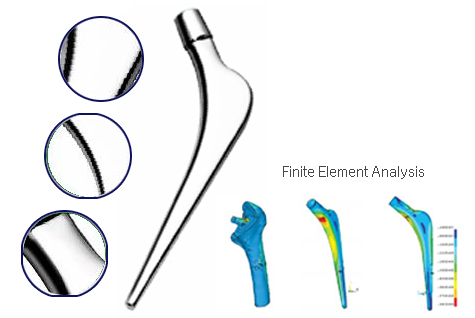
Tapered polished MultiFitTM cemented stem designed to decrease stress shielding of proximal femur and to increase rotational stability with comparative assessment by finite element analysis. |
The Stem due to its cross section of the neck geometry being track
formation achieves maximum range
of motion.
The cement stem is composed of Co-Cr alloy
with sound biomechanical designed neck
shaft angle formulating 132 degrees. It is also
designed to have anatomical medial curve
within the neck.
The cement collarless stem has overall highly
polished surface that minimizes friction
between the stem surface and cement.
Also the triple taper, which is wedge shape,
reduces shear stress and tensile hoop stress.
This provides reduction in stress shielding and
subsidence and promote rotation stability with
excellent self-locking taper.
|
| |
| Cement Collared Stem
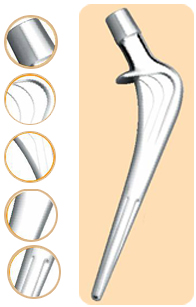
The cement collared taper, which is wedge shape, reduces shear stress while increasing
the compress stress and tensile hoop stress. This provides reduction in subsidence and
promote rotation stability with excellent self-locking taper. The connecting taper to ball head has clinically proven 12/14 taper with
surface roughness. This enables both metal taper and ceramic head to fit with more stable configuration.
Proximal textured surface increase
strength of cement-stem interface.
The cement collared stem is composed of
Co-Cr alloy with neck shaft angle
formulating 132 degrees. It is also design
to have anatomical medial curve within
the neck.
Grit blasted satin surface finish on
entire stem shaft.
Distal flutes increase rotational stability.
|
| |
| Acetabular System (Seal lock™)
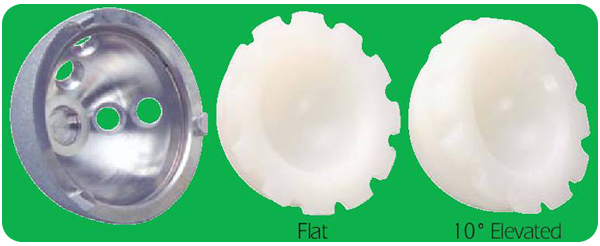
Acetabular component is composed of Ti-6Al-4V ELI biomaterial and its anatomical structure conforms the most common and popular design and shape, which is hemispherical acetabular component. The design focused on to minimize the stress concentration, which in turn will minimize the debris production. |
|
· UHMWPE · |
 |
Assembled with 28mm head, acetabular component enables mean 140 degrees of ROM. At the lower portion of acetabular component, a barrier for rotation and direction control exists, which give motion till 120 degrees. |
|
 |
In the Flat liner, direction control sulcus exists to control 40 degree of motion.
10 Degree Elevated liner allowed approximately 30 degrees of rotation |
|
 |
It is easy to assemble with firm spring locking fashion. |
|
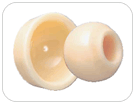 |
Ceramic on ceramic bearing couple The most logical approach in wear resistant tribology |
|
|
| |
| Bipolar System
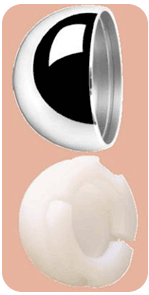
As downward force is applied, the 2 different points of rotation between the shell and femoral head center align themselves to the proper anatomical position and proper load distribution. These stable action can be achieved through the principle of positive eccentricity.
|
 |
|
 |
This dual articulation was primary inner articulation to reduce secondary outer acetabular articulation and acetabular wear. |
| |
|
 |
The bipolar cup system was designed to require very little pressure to snap the polyethylene insert over the femoral head and next, to slide the metal cup over the insert. In revision cases, the bipolar cup system can be easy disassembled and removed with intact femoral head. |
| |
|
 |
Because the insert designed to be unitary structure, generation of debris from the impingement between parts can be minimized compared with other liners in the market. |
|
|
| |
|
|
|